Coming in English
L'hygiène de l'égoïsme
100 blunt truths to make yourself your own first choice
You've said yes to everyone for as long as you can remember. A hundred pages to understand why, and to stop.
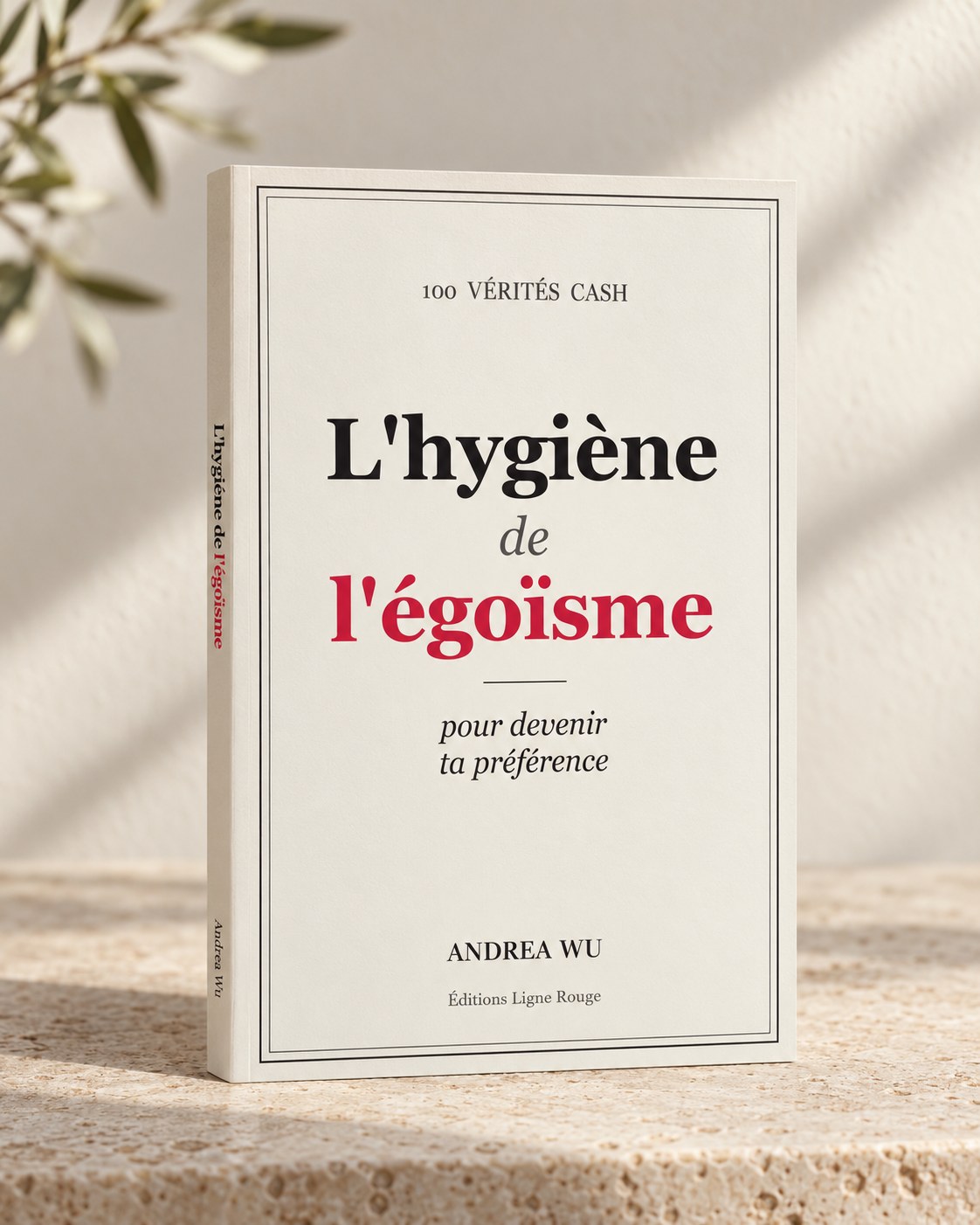
Introspection notebook · 100 truths · 120 pages
100 blunt truths to make yourself your own first choice
You're not kind. You're afraid.
Afraid of disappointing people, afraid of the silence that follows a no, afraid of the face they'd make. So you say yes. To everyone. You always have.
This notebook is not going to comfort you. It is going to tell you a hundred things nobody tells you, because everyone around you has an interest in you carrying on exactly as you are. One truth per page — blunt on the surface, gentle underneath. Three questions to find where it lands. And lines to write it down.
The English edition is in preparation. The French edition is already out — read it in French.
Order the notebook — $14.99 Kindle edition — $4.99
Paperback 6 × 9 in, cream paper, 120 pages. Shipped by Amazon. Also available as an ebook.
A guide tells you what to do. This notebook makes you look. Every page holds one truth that stings, one instruction to carry out the same day, three questions that send you back to what you actually feel — in your throat, your stomach, your shoulders — and the space to write it down.
Because reading a truth makes you think for five minutes, and then it fades. Writing it in your own words makes it stay. That isn't a hunch: James W. Pennebaker, professor of psychology at the University of Texas, has been measuring it since 1986. What you write down, you have named — and what you have named stops going round in circles.
I. What you call kindness — the diagnosis.
II. What they do with your availability — other people.
III. No: a user's manual — the practice, sentence by sentence.
IV. Guilt, that subscription — how to cancel it.
V. What happens when you come first — the way out.
Selfishness comes from self. It isn't a flaw. It's a form of hygiene.
Have you noticed that you say yes before you've even understood the question? Kindness that can't say no isn't kindness. It's an insurance policy against rejection. You pay the premiums every single day — in time, in energy, in evenings — and you call it having a good heart. For them, it's convenient.
Now do this: at the next request, count to three before you answer. Three seconds, that's all. Watch what happens in your stomach while you count.
Not "no, but…", not "no, sorry, it's just that…". Just no, one word and a full stop — because everything you add after it is a door you reopen. You owe nobody an explanation. If you give one, it's because you're afraid a bare no won't be enough. It is.
Now do this: one no, with nothing behind it, and count the words. If you say more than one, you start again tomorrow.
Anyone can walk in, at any hour, for anything. You think that's normal; you say you're "open". Other people mostly find it convenient. And yet a door you can close isn't an unkind door — it's just a door that protects something. There's someone in there. That deserves a lock.
Now do this: put your phone on silent for one hour a day, always the same hour, and tell no one.

Andrea Wu spent years as the person everyone could count on: a large family, three children raised alone, a lot of friends. She liked it that way. What she hadn't seen was that counting on her had become so easy that nobody stopped to wonder what it cost her. One evening, from the kitchen, she heard her family talk about her as a given: "We'll just ask Andrea." And they laughed. That was the day she understood she was no longer a whole person in that family, but a solution — someone who drops everything in order to be nothing else. She knows what it weighs. She stepped back. And years later she wrote this notebook, because there are a great many women who are the Andrea she used to be.
She eventually put a five-hour train ride between her family and herself — and just as much distance between the woman she was and the woman she is.
The English edition of L'hygiène de l'égoïsme is in preparation, along with the German, Spanish and Italian editions. Leave your email and you'll hear the day it goes on sale — before anyone else.
You'll also get the companion notebook free: the hundred "Your turn" pages of the book as printable sheets — one page per truth, with the three questions and the room to write. Essential on a Kindle, handy on paper when a page fills up.
You leave your first name and your email, you get one message, you confirm with a click. Unsubscribe in one click, any time.
Your details are used only to send you the companion notebook and news from the publishing house. Data controller: SAXO APP LTD.
Everyone stalls on the first line. Here are the sentences that come up most often, and the short answer to each.
Nobody is going to read these pages. In Pennebaker's studies, spelling and style count for nothing: only the act of writing changes anything. Write the way you talk, cross things out, abbreviate. This isn't an essay. It's a place to put down what weighs.
That's why there are three questions before the lines. Answer the first one, even in three words. If nothing comes, write "nothing is coming" and why you think that is. That's already the answer.
One truth, three questions, five lines: ten minutes. Pennebaker had people write for fifteen minutes on four consecutive days, and that was the whole protocol. You don't have to finish the notebook. You have to open a page.
Then write knowing you can tear the page out afterwards. What counts happened while you were writing, not in what's left behind. The companion notebook exists partly for this: a loose sheet can be kept or thrown away.
Of course you do: you're in the habit of putting yourself last, including here. Don't aim for a routine. Aim for the next page, once. Then once more. A hundred truths can be read in any order and picked up wherever you like.
Then type. What was measured is the effect of putting things into words, not the effect of the pen. The hand does have one advantage: it slows you down, and people cheat less when they go slowly. But typing beats writing nothing.
You know it vaguely. Written down, it becomes precise: who, when, how many times, and what it does to you. What you have named stops going round in circles; what stays vague carries on.
Notebooks that don't comfort you. Always the same format: a hundred truths, one per page, three questions, and lines to write on. You already know the questions — they're the ones you don't ask yourself, and that stay anyway. A question with no answer doesn't disappear; it lodges somewhere — the throat, the stomach, the shoulders — and waits. These three questions go and find it where it settled. It goes without saying, but it goes better in writing: nobody changes by reading. People change by writing.
Why lines, and not just pages to read
We've always known that writing takes part in healing. Diaries, letters never sent, grief journals, confessions — whenever it weighs too much, people reach for a sheet of paper. What Pennebaker added was the measurement. In 1986, James W. Pennebaker, professor of psychology at the University of Texas, asked students to write for fifteen to twenty minutes a day, four days running, about whatever had marked them most — not for anyone, not well, just to put it down. In the months that followed, they visited the university health centre less often than students who had written about neutral subjects. Hundreds of studies have repeated the experiment since: putting words to what weighs, by hand, in a few short sessions, measurably improves mood and health. The effect is modest, but it is there, and it holds.
That's why every truth ends with three questions and a set of lines, and why the companion notebook turns those hundred pages into printable sheets: reading is understanding; writing is naming — and what you have named stops going round in circles.
100 blunt truths to make yourself your own first choice
You've said yes to everyone for as long as you can remember. A hundred pages to understand why, and to stop.
More notebooks are in preparation, in the same format. Readers on the list hear first, before anyone else. Join the list.